Double Master's Programme in Economics
in cooperation with Keio University in Tokyo
Key facts

| Partner: | Keio University in Tokyo, Japan |
| Programme structure: | First year at the University of Cologne, second year at Keio University |
| Degrees: | Master of Science (M.Sc.) in Economics from the University of Cologne Master of Arts (M.A.) in Economics from Keio University |
| Duration: | 4 semesters |
| Start: | Fall term (October in Cologne) |
| Language: | English |
Programme
- Develop a better understanding of economic and social issues, such as the design and regulation of markets, individual behavior, public and monetary policy and taxation
- Gain exposure to a variety of theoretical approaches
- Receive state-of-the-art training in quantitative and qualitative research methods and data analysis tools
- Learn how to apply these methods and tools to independently analyse and develop conceptual models to predict responses to changes in policy and market conditions
- Develop ideas on how to solve complex economic problems in a globalised, interconnected world by considering cross-national linkages and implications
Benefit from the expertise of two leading universities. Upon successful completion of your studies, you will be awarded both master’s degrees: a Master of Science in Economics from the University of Cologne and a Master of Arts in Economics from Keio University.

"It is a huge privilege to study at these great institutions. The opportunity to gain such diverse experiences and make friends from all over the globe is unique and enriches my understanding of the world. I am certain that these skills will help me to become a better economist. The programme is ideal for students who want more than just a degree in economics."
Valentin Edert, Student of the programme
Partner: Keio University
Keio University is a leading university committed to excellence and innovation in education and research. It is located in central Tokyo. The mission of the Faculty of Economics at Keio University is to provide its graduate students with the highest level of economic knowledge and skills to solve real-world problems, and to develop talented individuals with advanced professional skills, whether they pursue research or careers in business.

Courses
The courses offered by the two universities cover a wide range of topics and complement each other very well. The double degree is integrated into the regular master's programmes. It includes courses from both universities and is based on credit transfer.
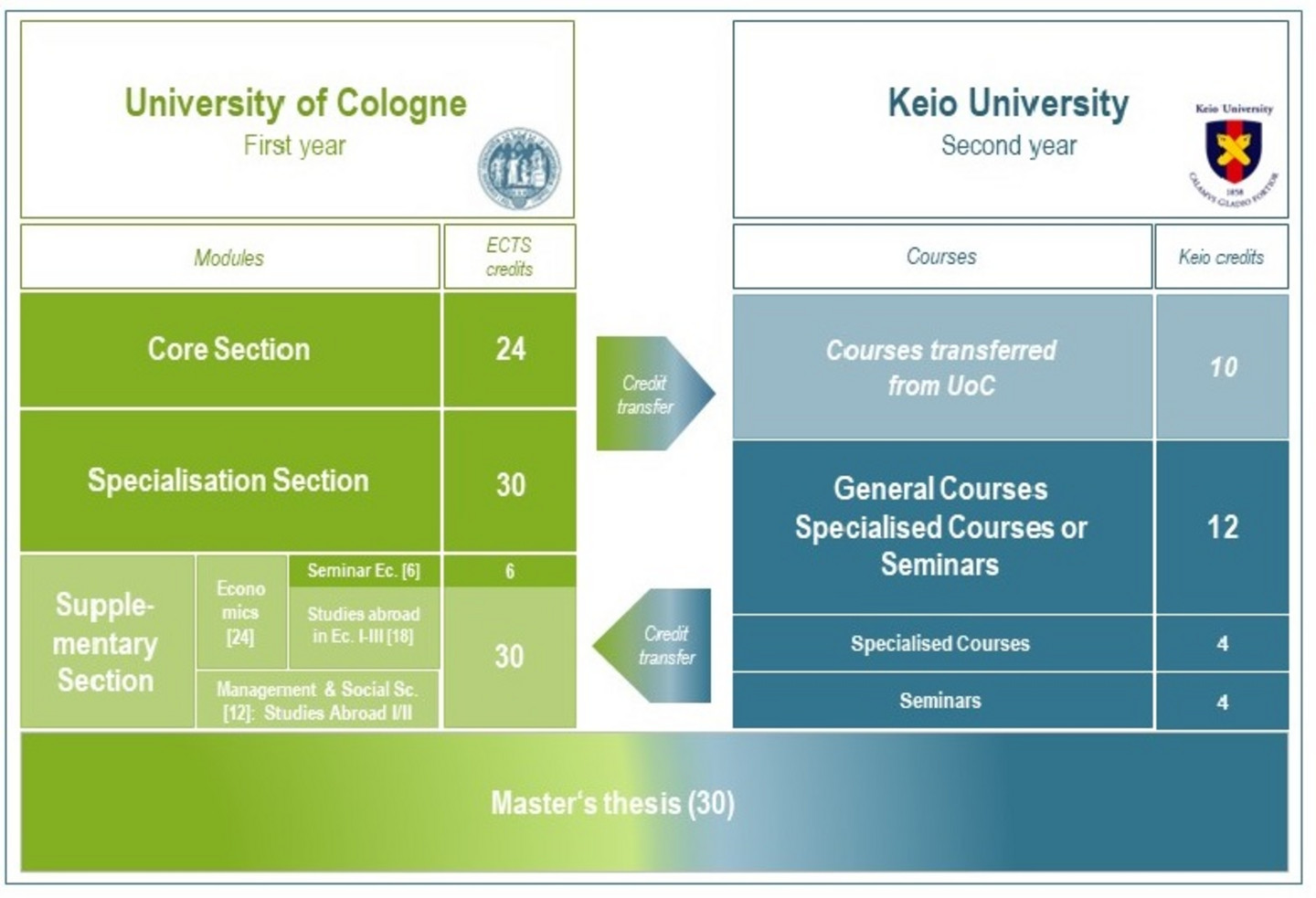
You will study the courses marked in dark green and dark blue. By means of credit transfer, you will be able to transfer the credits that you do not study at the University of Cologne to Keio University and vice versa (marked in light green or light blue).
As part of the programme, you will write a Master's thesis in your second year.
Courses at the University of Cologne
Courses at Keio University
Career opportunities
Graduates of the Double Master's Programme in Economics will be well prepared for careers with an international focus. Possible roles include:
- positions in public institutions such as ministries, government departments, central banks, agencies and public authorities (such as antitrust divisions or regulatory authorities) or international institutions (such as the OECD, IMF, World Bank or the European Commission);
- economic advisor in a government ministry or economic advisor to a political party;
- researcher in an academic or research institution;
- positions in economic departments of private institutions such as banks, consultancies, large industrial corporations, organisations or companies in the media sector;
- analyst in a financial institution or manager in an investment bank;
- in-house economic journalist.
Application

Find out about the entry requirements and how to apply for the programme.
Contact
Would you like to know more about the programme? Get in touch with the Programme Manager:
Xenia Elbrächter
Programme Manager
- Phone: +49 (0)221 470-7702
- Email: Contact form